Explicit Diffusion
The Explicit Diffusion block uses a forward stepping finite-difference method to propagate background error covariances by numerically solving the explicit diffusion equation. In one dimension, the diffusion equation is:
where \(u^i\) represents the analysis increment at grid index \(i\). The iteration index \(n\) represents a step in propagating the covariance across the grid, and though it is related to \(\Delta t\), neither of these quantities represent an actual time (measured in seconds or hours). \(k\) is the diffusion constant which (along with \(\Delta t\)) sets how ‘quickly’ an impulse from observations will propagate to nearby grid points.
On a 1D grid with \(N\) points, there is one diffusion equation for each grid point resulting in a system of \(N\) equations which can be easily translated into a sparse matrix equation – with the signature 3-point, 1D laplacian stencil element \([..., 0, 1, -2, 1, 0, ...]\) along the diagonal – and directly solved. In 2D, a 9-point stencil is typically used:
There is physical significance in how the values in the stencil elements sum to zero. When a physical substance diffuses, more substance is not created nor is the substance destroyed. In the 1D case, the stencil is reflecting the diffusive property that 2 units of the substance leaves a point \(i\) and one unit moves left (to point \(i-1\)) and the other unit moves right (to the point \(i+1\)). If the initial concentration of the substance has a peak value of 1, then this peak will decrease as the substance diffuses. This conservation property does not apply with the application of a B matrix on an analysis increment. In background error modeling, the correlation (corresponding to the concentration in the physical analogy) should have a peak at 1, since the peak of the error correlation within the B matrix occurs along the diagonal, representing the error correlation of a grid point with itself.
To keep the peak error correlation at a value of 1 throughout the iterative application of the explicit, forward-stepping a calibration factor must be pre-calculated and applied at each iteration.
For a simple example, consider how a gaussian shaped impulse is propagated by a diffusion operator:
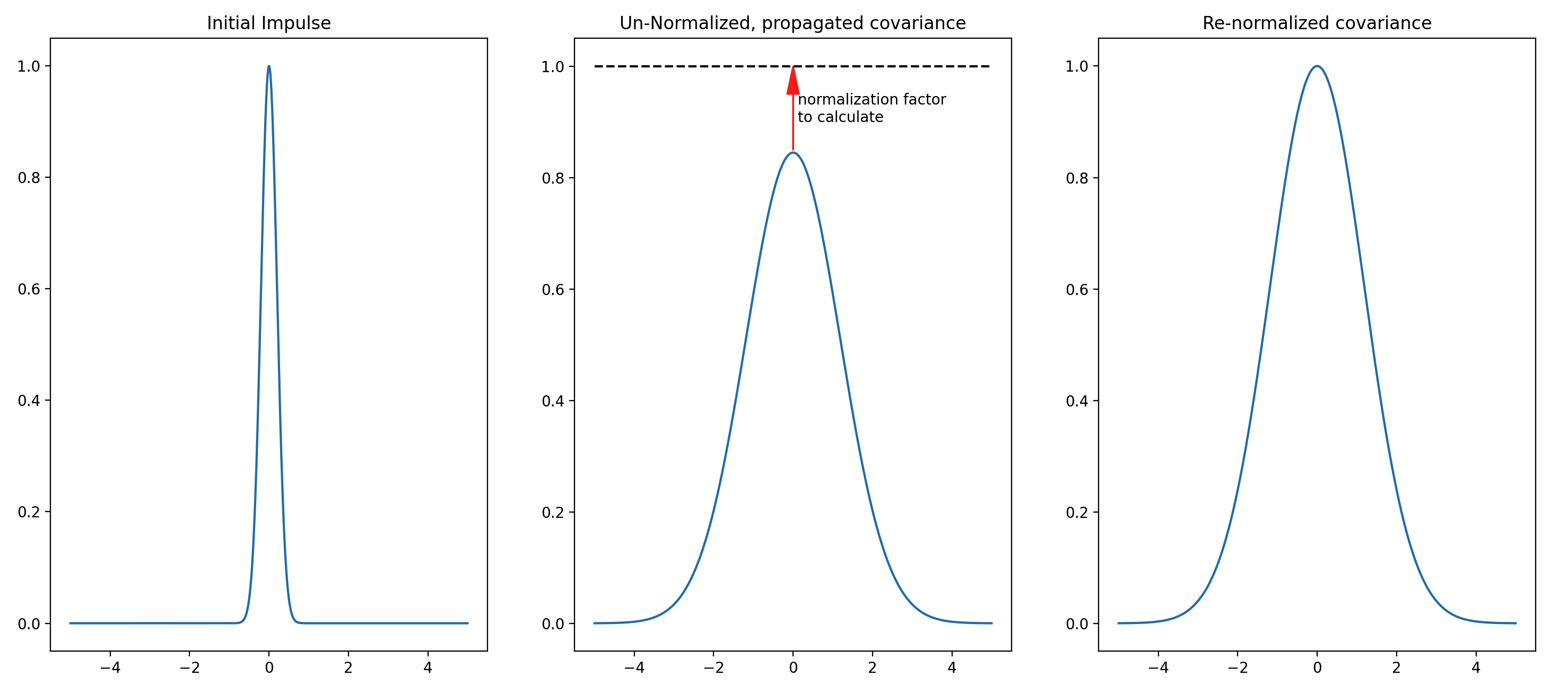
Fig. 9 Illustration of the calibration process for the Explicit Diffusion block in 1D. The curves on the left and in the middle of this illustration have not been drawn to scale in order to more clearly demonstrate the process. In a real case, the areas under the curves on the left and in the middle are equal.
Calibration Method
Many SABER blocks, especially central blocks, require a calibration process for tuning the block to the specific case in which it will be used. The calibration for the Explicit Diffusion block has factored the process into a horizontal (2D) part and a vertical (1D) part. In total, the two parts determine the normalization needed to maintain the peak correlation as close to 1 as possible, for each grid point, through the iterative application of the diffusion operator when the block is applied as part of a B matrix.
The horizontal normalization process uses a ‘randomization method’ (as described in
[WCMP21]) which is related to, but distinct from, the randomization
mode of The ErrorCovarianceToolbox Application. Both refer to the process of applying the
square root of the B matrix to a vector of random perturbations to produce an
ensemble member. The randomization method for calibrating the Explicit Diffusion
normalization uses the SABER randomization procedure. The calibration process
iteratively produces a state (utilizing the SABER randomization), applies the forward
diffusion operator, and updates a set of statistics. The number of iterations is set
by the user in the application’s configuration (see the example in Calibration Example).
After all the iterations are completed, the final set of normalization coefficients are
calculated and written out to a file.
This horizontal calibration can occur off-line and is grid-specific, so the file produced can be reused in new applications as long as the B matrix grid does not change.
The vertical normalization process is more straight forward and faster computationally since
it takes advantage of how vertical columns of points in an atlas::Field are entirely
owned by a single PE. To determine the vertical normalization, the full B matrix is applied
to a dirac ‘sheet’ (a state with 1’s at all points on a single level and 0’s on all other levels)
for each level, and a normalization value is calculated for each column.
For covariance modeling in the ocean (where vertical structure, e.g. the vertical location of the thermocline, can change on short time scales), this vertical normalization typically occurs on-line at each DA cycle.
Practical considerations
The ratio of \(\dfrac{k\Delta t}{\Delta x^2}\) encodes the CFL condition: a trade off between the stability of the method and how quickly it will run. If the ratio is too large (i.e. \(k \Delta t \gtrsim {\Delta x^2}\)), the method will be unstable and produce an unphysical representation of background errors. This value is not set by a user, instead the Explicit Diffusion block calculates a value for \(k \Delta t\) that satisfied the CFL condition based on the smallest grid spacing of the B matrix grid geometry.
This instability associated with large values of \(\Delta t\) is a practical reason the Explicit Diffusion block is better for modeling short-scale background error covariances: it would take too many iterations to ‘diffuse’ the long-scale errors.
Also, the matrix form of the finite difference diffusion equation makes it relatively simple to apply complex boundary conditions, like a land mask. This makes diffusion an advantageous method for modeling background errors in the ocean.
YAML configurations
Calibration Example
The calibration (error covariance training) mode calculates the normalizations which keeps the ‘peak’ correlation at 1 (instead of decreasing to a lower value), and writes the normalization coefficients to a file. The length scale for the covariance (either the localization length if used as an ensemble B, or the correlation length if used as a static B), is set in the calibration step.
To set the localization length(s), users have the option to set a single, global value
using the fixed value: key, or users can read in a model file to set a
location-dependent localization scale. These options are demonstrated, respectively,
in the horizontal configuration and vertical configuration in the
example below:
saber central block:
  saber block name: diffusion
  calibration:
    normalization:
      iterations: 1000 #sets the number of calibration iterations
    groups:
    - horizontal:
        fixed value: 3000.0e3 #sets the localization length scale (in meters)
      write:
        filepath: <path/to/data>/<horizontal_normalization_filename>
    - vertical:
        model file:
          ... # configuration for reading a model file
        levels: <num_levels> # MUST MATCH the number of levels in model
        as gaussian: true
      write:
        filepath: <path/to/data>/<vertical_normalization_filename>
A recommended number of normalization iterations (which only applies to the
horizontal calibration) for an operational configuration is 20,000. This value is
independent of the grid size/resolution. Ideally, this value is as large as
computationally feasible/practical.
Variational Example
After calibration, when using the block to apply background errors to an analysis increment, simply point to the files produced by the calibration step. The number of iterations required to reach the length scale set in the calibration is pre-calculated by the block.
saber central block:
saber block name: diffusion
read:
  groups:
  - variables: *vars
    horizontal:
      filepath: <path/to/data>/<horizontal_normalization_filename>
    vertical:
      levels: *levels
      filepath: <path/to/data>/<vertical_normalization_filename>
Implicit Vertical Diffusion (optional)
The vertical direction can optionally use an implicit scheme instead of the
explicit forward-stepping described above. It is selected per group by adding
method: implicit (and optionally iterations:) to that group’s
vertical: block — i.e. the same nesting as in the calibration and
variational YAML examples above:
saber central block:
  saber block name: diffusion
  calibration:
    normalization:
      iterations: 1000
    groups:
    - horizontal:
        fixed value: 3000.0e3
      vertical:
        fixed value: 2.0
        levels: *levels
        as gaussian: true     # optional; default false (GC half-width)
        method: implicit      # "explicit" (default) or "implicit"
        iterations: 4         # number of implicit iterations M (must be even, >= 2; default 4)
      write:
        filepath: <path/to/data>/<vertical_normalization_filename>
The implicit scheme solves \((I - \alpha \nabla^2_z)^M \psi = \psi_0\) per column by applying \(M\) successive tridiagonal solves of \((I - \alpha \nabla^2_z)\) rather than forming or solving the powered operator directly. The single tridiagonal factor \(I - \alpha \nabla^2_z\) is symmetric and is pre-factorized once (\(LDL^T\)) at setup and reused on every multiplication. The scheme is unconditionally stable, so the vertical iteration count no longer grows with the CFL-like constraint that the explicit scheme must respect — especially useful on stretched vertical grids (e.g. near-surface layers in ocean models) where the explicit path requires many iterations.
Length scale convention. The resulting correlation kernel is a Matern function with smoothness parameter \(\nu = M - 1/2\) in 1D (so \(M=2\) gives Matern-3/2, \(M=4\) gives Matern-7/2, \(M \to \infty\) gives a Gaussian). In 1D the kernel’s Daley length scale \(L_d\) satisfies \(L_d^2 = \alpha \cdot (2M - 3)\) for \(M \ge 2\), so the block computes
at each interface, with \(L_d\) being the Daley length scale of the output kernel (in levels). For \(M=2\) this reduces to \(\alpha = L_d^2\). This matches the convention in variational DA (Weaver et al. 2021) and is consistent with the explicit scheme’s length scale (for the Gaussian kernel there, Daley length = \(\sigma\)).
Gaspari-Cohn input. When as gaussian: false (the default), the
user-supplied length is interpreted as a GC compact half-width and the same
empirical \(1/3.67\) factor the explicit scheme uses is applied to get the
Daley length. The output kernel is still Matern (not GC) — the factor matches
effective range, not kernel shape. Users who need a genuinely compactly supported
localization should use the explicit scheme.
Horizontal diffusion is unaffected and still uses the explicit scheme. See Mirouze & Weaver (2010, https://doi.org/10.1002/qj.643) for the mathematical background of implicit diffusion, and Weaver et al. (2021, https://doi.org/10.1002/qj.3918) for normalization details.
More Information
Deeper descriptions of how the calibration procedure and horizontal/vertical splitting are implemented in SABER are available in the reference below (note, the reference discusses implicit diffusion, but the splitting and calibration procedures are implemented in the Explicit Diffusion block as described in the paper):
Weaver AT, Chrust M, Ménétrier B, Piacentini A. An evaluation of methods for normalizing diffusion-based covariance operators in variational data assimilation. Q J R Meteorol Soc. 2021; 147: 289–320. https://doi.org/10.1002/qj.3918